

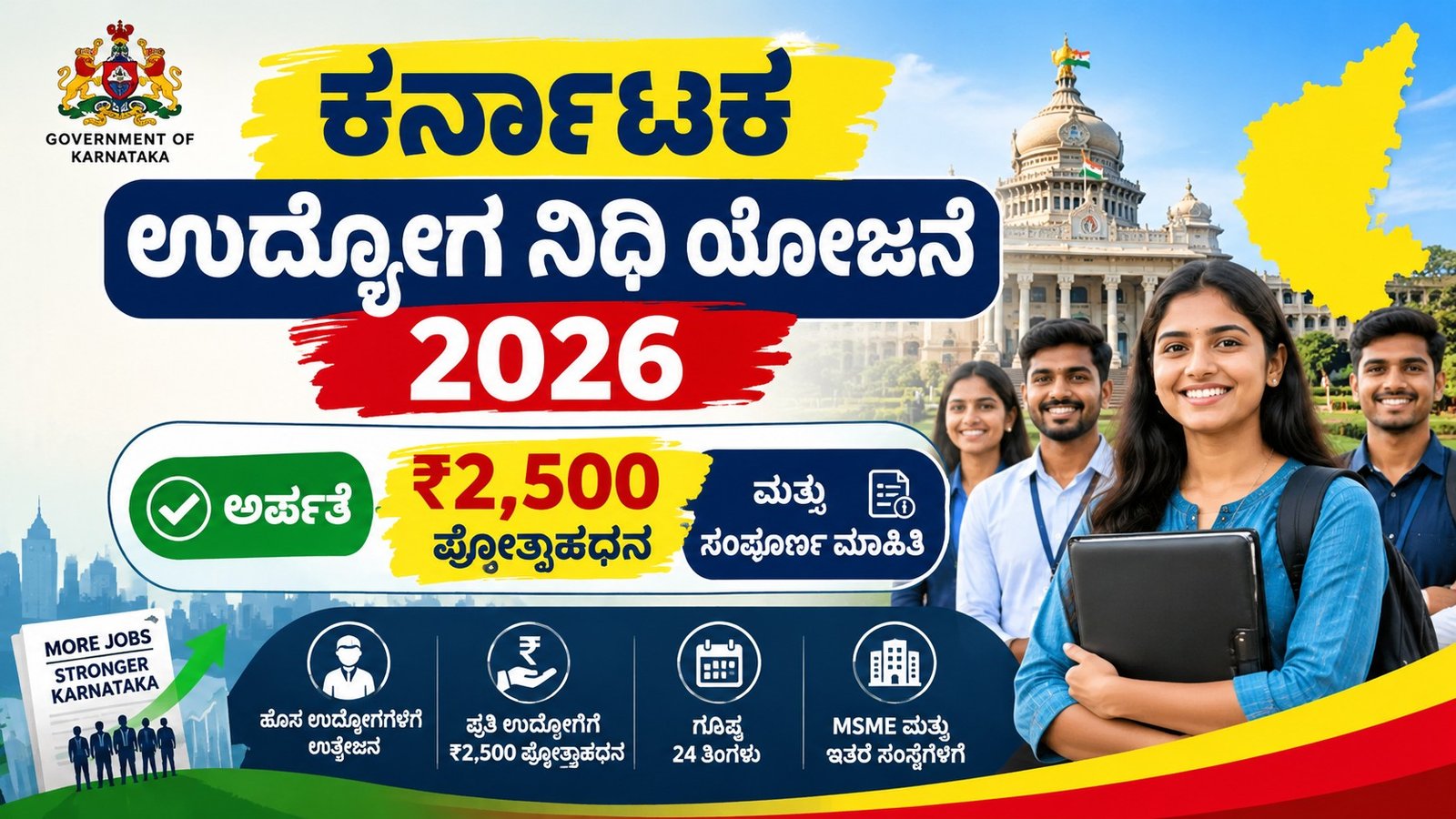
Udyoga Nidhi Scheme 2026: ₹2,500 Incentive and Employment Creation in 11 Districts
Udyoga Nidhi Scheme 2026 is an important initiative of the Karnataka Government aimed at creating new employment opportunities in backward and less-developed districts of the state. The scheme focuses on attracting industries and investments to these regions and creating local employment opportunities for educated and skilled youth.
While cities such as Bengaluru, Mysuru and Mangaluru continue to generate a large number of employment opportunities, many young people in districts of Kalyana Karnataka and North Karnataka still face difficulties in finding suitable jobs. As a result, many educated youth are forced to migrate to major cities in search of employment.
To address this regional imbalance, the Karnataka Government has introduced the Udyoga Nidhi Scheme.
The scheme received approval during the Karnataka State Cabinet meeting held on September 11, 2026. Information about the scheme was shared by Priyank Kharge, Minister for IT/BT and Rural Development & Panchayat Raj, through an official government communication.
In this detailed guide, we explain the Udyoga Nidhi Scheme 2026, including its objectives, how it works, beneficiary districts, benefits, eligibility, documents, expected application process and frequently asked questions.
Udyoga Nidhi Scheme 2026 – Quick Overview
| Particulars | Details |
|---|---|
| Scheme Name | Udyoga Nidhi |
| Approval Date | September 11, 2026 |
| Announced by | Priyank Kharge |
| Implementing Department | Department of Commerce and Industries |
| Number of Beneficiary Districts | 11 Backward Districts |
| Employment Target | 1,00,000 New Jobs |
| Monthly Incentive | ₹2,500 per New Employee |
| Maximum Incentive Period | 24 Months |
| Maximum Benefit per Job | ₹60,000 |
| Annual Allocation | Approximately ₹305 Crore |
| Beneficiaries | MSMEs and Industries Creating New Jobs |
| Linked Scheme | Yuva Nidhi |
| Main Objective | Reduce Regional Imbalance and Migration |
The main focus of the Udyoga Nidhi Scheme is on two areas:
- Attracting investments and industries to backward districts.
- Creating sustainable local employment opportunities for youth.
How Does the Udyoga Nidhi Scheme Work?
The Udyoga Nidhi Scheme can broadly be understood as a wage subsidy or employment incentive model.
Under this scheme, the government does not directly provide ₹2,500 to unemployed youth. Instead, eligible MSMEs and industrial establishments that create new employment opportunities in the targeted districts will receive an incentive of ₹2,500 per newly recruited employee per month, for a maximum period of 24 months.
This means that an eligible employer could receive up to:
₹2,500 × 24 months = ₹60,000 per new employee.
The objective is to reduce the initial employment cost for industries and encourage businesses to establish or expand their operations in less-developed districts.
The government is expected to verify new employment and salary payments before releasing the incentive. This type of verification is intended to ensure that the benefit is provided only for genuine new employment.
An important feature of the scheme is that the incentive is linked to actual employment creation. Simply operating a business in a backward district would not automatically qualify an establishment for the incentive. The business would need to meet the conditions prescribed under the final government guidelines.
Example of the Udyoga Nidhi Incentive
Let us understand the scheme with a simple example.
Suppose an entrepreneur starts a food processing unit in Bagalkot district and recruits 50 local youth.
If the eligible incentive is ₹2,500 per employee per month:
- Number of new employees: 50
- Government incentive per employee: ₹2,500 per month
- Monthly incentive for 50 employees: ₹1,25,000
- Maximum period: 24 months
- Total possible incentive: ₹30,00,000
- Maximum incentive per employee: ₹60,000
Therefore, if all 50 employees remain eligible for the full 24-month period, the employer could potentially receive an incentive of up to ₹30 lakh under the scheme.
This is only an illustrative example. The actual benefit will depend on the final eligibility conditions and implementation guidelines issued by the Karnataka Government.
The objective of this incentive is to reduce the initial cost of employment and encourage businesses to create additional jobs in targeted districts.
Udyoga Nidhi and Yuva Nidhi – What Is the Difference?
Many people may confuse Udyoga Nidhi with the existing Yuva Nidhi Scheme. However, these are two different initiatives.
The Yuva Nidhi Scheme provides financial assistance to eligible unemployed graduates and diploma holders in Karnataka who have completed their education and remain unemployed, subject to the scheme’s conditions.
The reported monthly assistance under Yuva Nidhi is:
- ₹3,000 for graduates
- ₹1,500 for diploma holders
The assistance is available for a maximum period of two years, subject to eligibility conditions.
Yuva Nidhi is therefore primarily focused on providing financial support to eligible unemployed youth.
On the other hand, Udyoga Nidhi is focused on employers and employment creation. Under Udyoga Nidhi, eligible businesses that create new jobs in the targeted districts can receive an employment-linked incentive.
In simple terms:
Yuva Nidhi → Financial support for eligible unemployed youth
Udyoga Nidhi → Incentive for eligible employers creating new jobs
The government has presented these initiatives as complementary measures, with one supporting job seekers and the other encouraging employment creation.
Districts Covered Under Udyoga Nidhi Scheme 2026
According to the information available regarding the scheme, 11 less-developed districts are expected to be covered.
The districts specifically mentioned in available information include:
- Kalaburagi
- Bidar
- Raichur
- Yadgir
- Bagalkot
Other districts have also been mentioned in earlier reports and discussions, including:
- Koppal
- Vijayanagara
- Gadag
- Haveri
- Vijayapura
- Belagavi
However, the complete and final list of 11 districts should be confirmed through the official Government Order and final implementation guidelines.
Therefore, applicants and businesses should not rely only on unofficial district lists. They should check the official notification issued by the Karnataka Department of Commerce and Industries or contact the concerned District Industries Centre (DIC).
Benefits for Entrepreneurs and Industries
The Udyoga Nidhi Scheme is primarily designed to encourage businesses to create employment in targeted districts.
Some of the expected benefits for eligible industries include:
1. Reduction in Initial Wage Costs
The employment incentive can help reduce part of the wage-related cost associated with newly created jobs during the initial period.
2. Encouragement for Local Investment
The scheme is intended to encourage industries and MSMEs to establish or expand their businesses in less-developed districts.
3. Support for Business Expansion
Businesses may be able to use the savings from employment incentives towards training, machinery, infrastructure or expansion, subject to their own business requirements.
4. Availability of Local Workforce
The scheme may help businesses connect with local educated and skilled youth looking for employment opportunities.
5. Regional Industrial Development
Greater industrial activity can potentially contribute to the development of local business ecosystems and employment opportunities.
Benefits for Young Job Seekers
Although the incentive is primarily provided to eligible employers, the scheme is intended to create employment opportunities for local youth.
Potential benefits include:
Local Employment Opportunities
Young people may have more opportunities to find jobs within their own district instead of moving to Bengaluru or other major cities.
Reduced Migration
More local employment opportunities could reduce the need for young people to migrate to large cities solely for employment.
Skill Development
New industries and businesses may provide opportunities for employees to gain practical experience and develop new skills.
Employment Experience
Working in formal businesses can help young people gain professional experience, which may be useful for their future careers.
Support for Local Economy
More local employment can contribute to increased economic activity in the district.
Eligibility Conditions for Udyoga Nidhi Scheme
The final eligibility conditions are expected to be specified in the official Government Order and implementation guidelines.
Based on the information currently available, businesses may need to satisfy conditions such as:
- The business or industrial unit should be located in one of the officially identified backward districts.
- The business should have the required registrations, such as Udyam Registration, wherever applicable.
- The incentive is expected to apply to new and additional employment, rather than existing employees.
- Newly recruited employees may need to satisfy local residency or domicile conditions prescribed by the government.
- The establishment must comply with applicable labour laws and wage requirements.
- Where applicable, statutory requirements relating to PF and ESI may need to be followed.
- The government may verify employment records and salary payments before releasing the incentive.
Important: These conditions should be treated as provisional until the final official guidelines are released.
Documents Required
The exact document list will be confirmed after the official implementation guidelines are issued.
For Job Seekers
Depending on the recruitment process, applicants may be asked to provide:
- Aadhaar Card
- Residence/Domicile Certificate
- Educational certificates and marks cards
- SSLC/PUC/ITI/Diploma/Degree certificates, as applicable
- Bank account details
- Mobile number
- Email ID
- Caste and Income Certificate, if applicable
For Businesses and Companies
Eligible establishments may be required to provide:
- Udyam Registration Certificate
- PAN details
- GST Registration details, where applicable
- District Industries Centre registration/details
- Company or business bank account details
- Payroll records
- PF/ESI records, where applicable
- Proof of industrial unit/business address
- Details of newly recruited employees
- Salary/payment records
Note: Additional documents may be required once the final guidelines are released.
Udyoga Nidhi Scheme 2026 Application Process
At present, the complete operational guidelines and dedicated online application portal are yet to be confirmed.
Therefore, the following should be considered an expected process, not a final government-approved application procedure.
Step 1 – Business Registration
Eligible businesses may first need to ensure that their business has the required registration, such as Udyam Registration or registration with the District Industries Centre.
Step 2 – Registration Under the Scheme
After the official portal is launched, businesses may need to register under the Udyoga Nidhi Scheme by submitting their business and establishment details.
Step 3 – Recruitment of Local Employees
Eligible businesses may recruit local candidates according to their normal recruitment process and the conditions prescribed under the scheme.
Step 4 – Submit Employee Details
The employer may need to submit details of newly recruited employees along with required employment and salary-related documents.
Step 5 – Verification
Government officials or the concerned department may verify the business, employee details, new employment and salary payments.
Step 6 – Submit Salary/Employment Records
Businesses may be required to periodically submit salary slips, payroll records, bank payment details or other proof showing that the employees continue to work.
Step 7 – Release of Incentive
After successful verification, the eligible employment incentive may be released to the eligible employer through the prescribed payment mechanism.
Step 8 – Continued Compliance
The employer may need to continue meeting the scheme’s conditions during the eligible period, which is expected to be up to 24 months.
Important: The above process is only an indicative guide. The exact application portal, procedure, documents, deadlines and verification process will be known after the official notification is issued.
Comparison with Other Employment Incentive Schemes
The wage subsidy model used for encouraging employment is not entirely new in India. Different central and state-level initiatives have included employment-linked incentives or industrial incentives.
The Employment Linked Incentive (ELI) framework at the central level is one example of an employment-linked policy approach.
However, the proposed focus of Udyoga Nidhi is on encouraging employment and investment in selected less-developed districts of Karnataka.
The scheme is also discussed alongside Yuva Nidhi, which focuses on providing financial assistance to eligible unemployed youth.
Therefore, the two schemes address different sides of the employment ecosystem:
Yuva Nidhi → Supports eligible unemployed youth
Udyoga Nidhi → Encourages eligible businesses to create employment
Possible Challenges
The success of the Udyoga Nidhi Scheme will depend on its implementation and the response from businesses.
Some possible challenges include:
Infrastructure
Employment incentives alone may not be sufficient to attract industries if adequate roads, electricity, industrial parks, logistics and other infrastructure are not available.
Timely Release of Incentives
Businesses may need predictable and timely release of incentives for the scheme to provide the intended financial support.
Verification
Strong verification mechanisms may be required to prevent false employment claims or misuse of the scheme.
Awareness
Small businesses and entrepreneurs in rural and backward areas need access to clear information about the scheme, eligibility and application procedure.
Availability of Skilled Workers
Industries may also require workers with specific technical and professional skills. Training and skill development may therefore remain important for successful implementation.
Udyoga Nidhi Scheme 2026 – Frequently Asked Questions
1. When was the Udyoga Nidhi Scheme approved?
The Karnataka State Cabinet approved the scheme on September 11, 2026, according to the information currently available.
2. How many districts are covered?
The scheme is intended to cover 11 backward or less-developed districts of Karnataka. The complete final district list should be confirmed through the official Government Order.
3. How much incentive is provided?
Eligible employers are expected to receive ₹2,500 per new employee per month, for a maximum period of 24 months, subject to the final conditions.
4. What is the maximum benefit per employee?
The maximum incentive is ₹60,000 per employee over 24 months.
5. Who receives the incentive?
The incentive is intended for eligible businesses, MSMEs and industrial establishments creating new employment, rather than being a direct unemployment allowance paid to employees.
6. What is the employment target?
The scheme has a target of creating approximately 1 lakh new employment opportunities in the targeted districts.
7. How much money has been allocated?
The scheme has been reported to have an annual allocation of approximately ₹305 crore, subject to the government’s final budgetary and implementation provisions.
8. Is Udyoga Nidhi the same as Yuva Nidhi?
No.
Yuva Nidhi provides financial assistance to eligible unemployed youth subject to its conditions, while Udyoga Nidhi is intended to provide employment-linked incentives to eligible employers creating new jobs.
9. Has the online application portal been launched?
The dedicated online application process and detailed operational guidelines should be confirmed through an official government notification. Applicants and businesses should avoid relying on unofficial application links.
10. What should businesses do now?
Interested businesses can keep their required registrations and business documents ready and monitor the official Karnataka Department of Commerce and Industries announcements for the final guidelines and application procedure.
Important Official Websites
For the latest information, applicants and businesses should check the official Karnataka Government sources.
Karnataka Department of Commerce and Industries
Kaushalya Karnataka Portal
The final application link, district list, eligibility conditions and deadline should be checked only after they are officially announced.
Conclusion
The Udyoga Nidhi Scheme 2026 is designed around employment creation and regional industrial development in Karnataka.
The scheme proposes an employment-linked incentive of ₹2,500 per new employee per month for up to 24 months, subject to the final eligibility conditions. The broader objective is to encourage businesses to invest in less-developed districts and create more local employment opportunities.
For young people, increased industrial activity could provide more employment opportunities closer to their hometowns. For eligible businesses, the employment incentive could help reduce part of the initial cost of creating new jobs.
However, the actual implementation of the scheme will depend on the final Government Order, district list, eligibility rules, application portal and detailed guidelines.
Therefore, job seekers and entrepreneurs should wait for the official notification before submitting any application or sharing personal documents through unofficial websites.
Important Note: This article is based on information available in September 2026. Since the detailed implementation guidelines may change, readers should verify the latest information through the official Karnataka Government website or the concerned District Industries Centre before taking any action.

“I’m Shrinivas, a Kannada blogger, digital marketer, and insurance advisor. I hold an MA degree and have 4+ years of experience in customer support and relationship management. I create simple and practical content on self-improvement, career growth, and government schemes to help people make better life and financial decisions.”